Showing posts with label novel Sri Lankan fiction. Show all posts

Wednesday, October 9, 2013

The Moon in the Water by Ameena Hussein


So there is this hangup of mine. I don't like reading books that everyone is raving about at the time it comes out. So despite many people telling me I must read this book, I took my time and I am glad I did or else I might feel I was influenced by their opinions.

 I had read her previous two books and I am a fan. In them she has a distinctive voice and a certain rawness that was appealing. And look at that cover! It is fabulous if not a little risqué.
This novel has more polish and is in a different style from her short stories. It is a very easy read and engaging from beginning to end. I might have done away with the Prologue but writers seem attached to them.
 Because Ameena Hussein is a Muslim, it is understandable that she writes a novel that deals entirely with a Muslim family. A young very modern (living together with her boyfriend, living in a foreign country working, educated abroad - is it realistic, I ask?) Muslim woman comes back to the country when her father dies in a bomb blast. She has one sister and two brothers. She is the eldest in the family. When she comes back, she realizes that she is adopted and that because of some convoluted aspect of Muslim Law she can't inherit from her father who dies without making a will. She also realizes that she has a blood brother and off she goes to find that brother who has had the most different life from her. She is not upfront about being his sister and I suspect he is falling in love with her and is mad with her for hiding that fact. They part on strained terms but later on start meeting and talking and also seem to be stepping over the boundaries that rule brothers and sisters. Then tragedy takes place and soon after the book ends.
I don't want to spoil the story which is why I stop there. Hussein, puts in everything and the kitchen sink: there is allusion to the war, there are debates on Muslim tradition, there is a big section on the JVP, there is the Tsunami, there is post tsunami rehabilitation, there is sibling unease over her adoption, there is anger, love, betrayal, friendship, etc etc . So despite its fairly slim size, it is a novel that speaks about a hell of a lot of things.
But don't let that frighten you. Hussein has a lovely easy writing style. While she may struggle a bit at the beginning, the novel gets stronger and better as you read along. While she may pontificate too much on issues, there is certainly food for thought. And when I came to the end of the novel, I was quite moved.
She has wonderful descriptions about the country, about the customs and traditions of the Muslim community and really lyrical passages on how the protagonist feels about love. My favourite characters were RaushenGul and Abdullah. The former the young woman's mother, who is quite a feisty woman in her own right and the latter, the young woman's fiancée who comes out as being sensitive and truly loving her. One of the loveliest passages for me was right at the end of the novel, when he goes to visit her before flying back to the home that they both shared without her accompanying him.
Perhaps as is often with first novelists, there is this need to talk about everything. I look forward to her second novel but I confess I like her earlier style compared to this one and hope she continues to develop as a writer.

Friday, March 29, 2013

There is something I have to tell you by Madhubashini Ratnayake

 To write a long novel needs skill, dedication, commitment and most of all a good long story to tell. Certainly Madhubashini Ratnayake has proved that she has enough of the first three and the Gratiaen judges thought she has enough of the last component, after all they awarded her the Gratiaen Prize for 2011 awarded in 2012 but I am not sure that she succeeded.
There is Something I have to Tell You is a fabulous title. The story is woven around a few characters, the walauwe son, the servant's son, the samanera living in the temple next door, the girl next door, the university rich kid, the revolutionaries, etc etc. Nothing we haven't read about before. But a good story can take an old theme and make you see it with new eyes. A good story can weave a fabric around your imagination filled with the colours and sounds of the writer's skill. Has Madhubashini Ratnayake done that? I am not sure. There is a story certainly, and it is a familiar story, nothing unusual, it talks about all the issues we as a country have gone through. But perhaps as happens to many first novelists they want to talk about everything that has happened in our entire history. If they could bring Vijaya's arrival into a modern novel as well, they would. So the novel is set during a time of post independence but there is constant reference to the pre-independence struggle as well as the ills of colonialism. Then we have the lean years, the JVP struggle and the LTTE (not dwelt on much but referred to). We have Sinhala nationalism, and Sinhala chauvinism, and the sane voices that to my mind didn't hold true. It was too much a nod to political correctness a token reminder of how things should be. But despite my misgivings and my holding back of praise, it is a novel that I would recommend one reads.
We have expected much from Madhubashini Ratnayake, she has given us some collections of stories that have received good reviews, so I was expecting a wonderful novel. It is a novel that could have been wonderful but is not. It could have done with much editing. In fact editing down. Five lines cut out of every ten, would have made it stronger and tighter and faster. It could have done with a spellcheck as well. It was a novel that I took a long time to finish and I would lose interest in it half way, which is not a good trait for a novel. It is certainly not an easy read. But I emphasise again, it is worth reading, because in my mind it deals with serious issues by a writer who is the backbone of the Sinhala middle class. . To me I saw the novel as a door into the writer's mind and others like her, of what they think of their own country and how they feel, truly feel about where their country is headed. She definitely has something to tell us but perhaps she could have done it better.

Thursday, September 8, 2011

Metta by Sunethra Rajakarunanayake


If all of you thought I had upped and gone, 'tis not so! I took a long break from reading books by Sri Lankan authors, so thank you for all the messages and inquires, and yep, I am still here.
A few days ago, my trusty aunt thrust this book into my hands and as I am always curious about what's happening in the Sinhala literature scene, grabbed it and read it.
What a book! I had not heard of Sunethra Rajakarunanayake (quite a mouthful, that last name) but when I googled her she seems to have published many books and won quite a few awards. The story is set in modern times - unlike English writing by Sri Lankans, the vernacular novels have moved far from the waluwa, oppressed labourers and exploitative landlords. A young woman Varnasi, an enigmatic man called Sasha, a mother and grandmother are the main characters. Sasha who once courted the mother is now with the daughter. Hmmm quite a love triangle there isnt it? I cant think of a single Sri Lankan novel in English that dares to deal with this kind of scenario. The daughter Varnasi, ignorant of her mother and Sasha's relationship refuses to listen to her mother's advice to stay away from Sasha. Sunethra R does not shy away from controversial and contemporary issues. Illicit pregnancy, female headed households, working mothers, and a country in conflict are themes that run through the novel.
If there is a criticism against the novel is that the portrayal of men is totally inadequate. Sasha seems to be the only man portrayed wholly and yet his portrayal is of a completely flawed man. The novel starts off well with Sasha's point of view but then he is reduced to a caricature only to be revealed to us through Varnasi and her mother. We never hear Sasha's point of view again and that is a pity. Also it could have done with a whole load of editing. The novel was unnecessarily too long and dragged on, weighting it down. The mother and daugter had similar voices and you could almost think it was the Author's views that were coming through both. While they were interesting and compelling characters it might have been nice to have diverse views especially when it came to expounding Buddhist philosophy. The book felt slightly preachy on a Buddhistic note. I had to do a double take when Varnasi talks about loving Sasha like a child instead of a lover and thought it was a bit sick! But then again maybe that is the ultimate love. And perhaps the author was juxtaposing carnal love with selfless love. All in all the book was a good read and I liked it.
But ... If I have a reservation at all about this book it is for the translation.
Many of the books that I read are translations and I never for a moment think that I am reading a translation. Isabel Allende, Umberto Eco, Marquez, Parmuk, Peter Hoeg and the list goes on and on. In those books the story flows, the English is natural and there is no theses at the beginning and end of the book. Sadly, Metta struggles only because of the translation, it is a testament to Sunethra R's story that you plow through the book regardless of the clumsy and heavy translation. It might be worthwhile for future translators to study how other authors like those mentioned above, all the Russian authors, even Coelho are translated without the reader being aware even once it was written in a language other than English.
It is my personal opinion that we have a long way to go in good translation but don't let it deter you from reading this book.

Friday, March 4, 2011

Froteztology by Marlon Ariyasinghe


Here is someone who thinks he is the 'bad boy' of poetry. From the title, from the third page onwards where Marlon says:


Write you bastards

Write till your ink runs dry

Write till 'they' lock you up

Write till your fingers are severed

When your ink runs dry,

Write with blood


you know you are going to be reading some powerful stuff. Or rather you hope that you would be. But then you turn the page and find the introduction written by Vihanga (whose books I have reviewed previously) who is all praise for Marlon, then goes on to describe his poetry as those with 'appreciable venom' and of course I am suspicious. What am I going to find beyond - poems with a huge chip on their shoulder or a true poetical commentary on the times of our day.

What you get is a mix. Some excellent poems like: I is wanting to Frotezt and I'm a Racist among others and some not so good poems like: Colombota kiri apita thaamath kekiri, where he just takes my poet goddess Vivimarie down. Surely you didnt think you could say things against Vivimarie and hope you get away with it in this blog!

But seriously, Marlon has oodles of talent but you will only find it after he has chipped away at the big block on his shoulder. Now this is what I can summarise from the poems, not having seeing the dude, or know anything else about him - Here is a guy who is angry with the world. He is angry that others can speak English better than he can, that they are more in the limelight than he is, that they are more successful than he is, that he epitomises village which is good and his enemy is the city, that he can't pronounce f and others can, that kekiri is just not as good as kiri, that if you are not in his circle of friends you are no good. That he thinks the universities (which one though - Colombo or Peradeniya, I suspect Pera coz of the Vihanga association) are the pits (Deconstructing post-structuralist farts/In our very own faculty of arts). And finally to top the whole thing, he came from Australia! Refer back cover. No shit! I is conpused! So is he the real thing or aint he?
Ok Marlon has all these grouses but what dude is he doing about it hiding it in a book? I think Marlon's poetry is most effective performed rather than read, perhaps that right dose of venom doesn't quite come out through the pages unless it is spouted at these literary gatherings. And to make it worse the bad boy merely comes out as complaining. But the overall verdict is here is a poet to watch, buy the book, as usual Sri Serendipity does nice graphics. No candy floss here, instead it is hard candy, but candy all the same, I say. Make your own mind up and as usual, since this is a buddy of Vihanga, I bet I will get slammed for this review. Bring it on boys :)

Friday, October 29, 2010

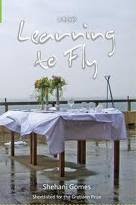
Learning to Fly by Shehani Gomes


Some people think I am wierd, for example I will never not buy a book because someone else didn't like it. I have to read it for myself. My friend told me that her mother had bought this book and not liked it but that she had. Previously a reader had left a comment that they loathed this author. So when I saw this on sale at the book fair, I had to buy it, I wanted to see what the fuss was all about. (I told you I bought a lot of loot at the book fair). The cover is just gorgeous and straightaway I knew that it was a sad story. You can kinda tell with the lonely table, the rainy day, the grey sea. And yes I was right, it is a sad story but told in such a way that it doesnt force itself down your throat in a sad way, but just says it the way it is.


Shehani Gomes writes for young people. And actually if I think about it, there are hardly any books that cater to the late teens early twenties crowd. The warped love story actually reminded me of a stupid obsession I had when I was fifteen with a guy who didn't even know I existed. Sigh! But luckily I came to my senses and realised that he wasn't worth it. Anyway back to Learning to Fly. The story can get kind of complicated. You have Kala, she has a best friend Sumi who dies in a car accident. Kala never really gets over Sumi's death and throughout the book you have her remembering incidents of both of them together. Kala has a blind sister and two working parents. The blind sister falls in love with the flute teacher who while he does have feelings for her marries another girl chosen for him by his parents. After all who wants a blind girl for a daughter in law, however pretty she may be? Then you have Dylan. Oh my lord! Dylan is a complicated bag of goods. He lost his father when he was young, his mother married again and there are traces of the wicked step father routine here. Dylan fantasises about building a tree house with his real dad. Dylan and Kala love each other but pretend that they are friends. Kala finishes school, grows up, gets a job, has an affair with her boss, is sacked, attempts suicide, mother dies, she recovers, meets someone else, marries him and has a baby. Dylan while interested in Kala, has an affair with Nadia who is another bag of complications (alcoholic, rich, indifferent parents, commits suicide). If I put you off the book with all that , I am sorry, because it is really a fabulous book. Shehani Gomes writes about serious things in a very unserious way that totally would appeal to the younger generation. I mean isn't this what we have all gone through - sometimes thinking life isnt worth living, doing anything to get your parents attention, having money (Ok not all of us have it but still) and your life still feeling empty. But I can also totally understand older people just not getting it. This book is too wierd for them, give them a soppy village love story any day and that they will lap up, but a book with real stories and real situations - Nah! that is just too real for them I suppose. Anyway, I loved the book, its definitely a keeper not to be given away to anyone. I will admit sometimes it a bit confusing and you go - what the heck just happened there - but give it a chance, and let me know if you liked it as much as I did. Judging from previous comments and reactions I have had with others, I am expecting the comments to just fly in.